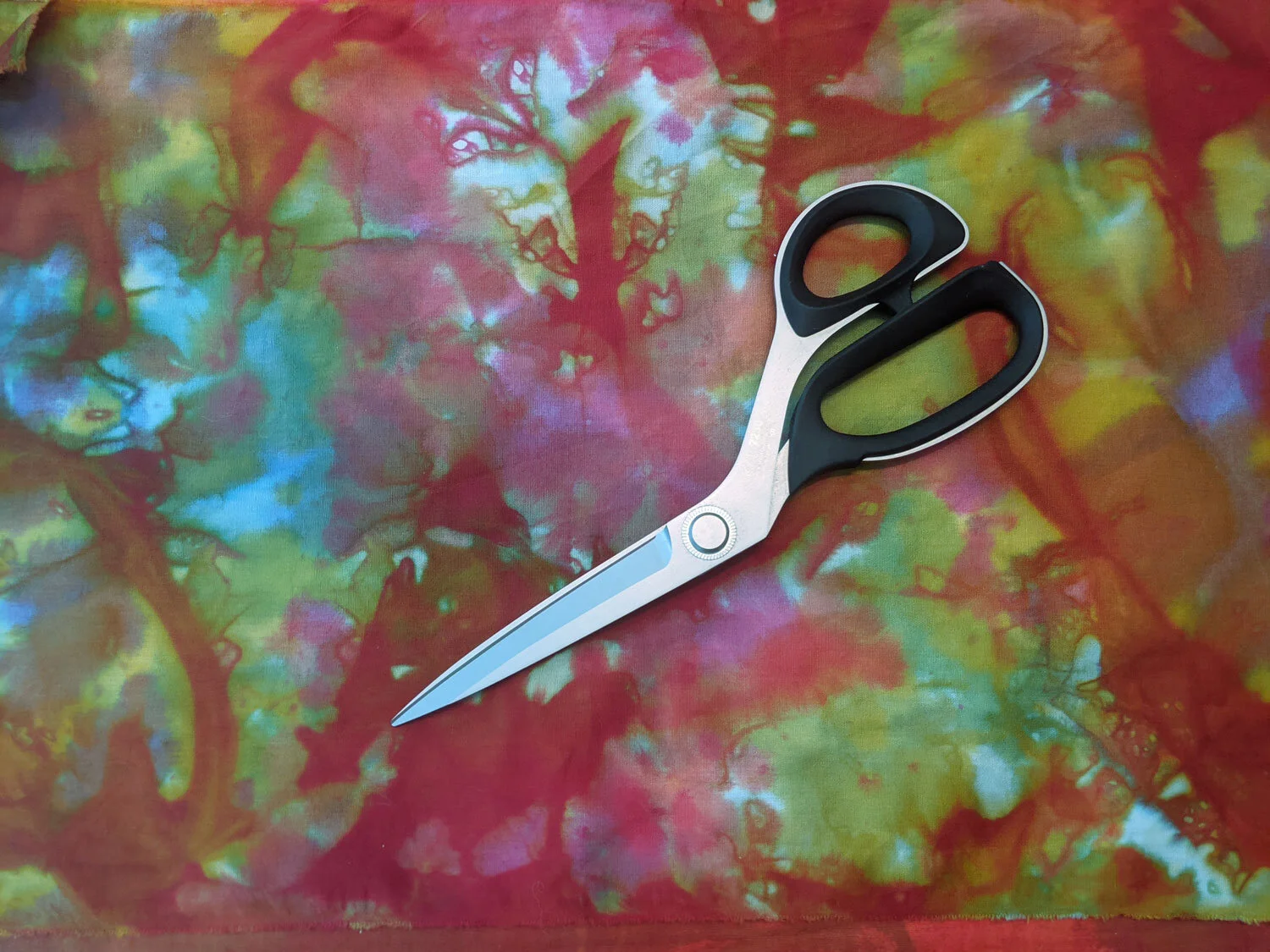
Moisture Variations in Dye Painting
Chapter 4 of Ann Johnston’s Color by Design is my favorite so far in our Dyeing Support Group. My favorite is the organic quality you get from painting on soda-soaked wet fabric and applying pressure to plastic over the top.
Thin Paste on Wet Fabric with Primary Colors - I like that you get secondary colors as the dyes bleed into each other; especially after pressing the plastic on top.
2nd sample of Thin on Wet Primary Colors
My Favorite - I love the surprise organic lines and shapes of the thin paste on wet soda-soaked fabric
Thin on Wet Secondary Colors and neutral created by adding the secondary colors together.
2nd Sample of Thin on Wet Secondary Colors
Textured Objects placed underneath wet soda-soaked fabric and thin dye painted with brush - I enjoyed this technique
Thin Paste on Dry Fabric is my least favorite. I can see circumstances where you would want less bleeding until the edges to keep some white or light areas. Maybe I would prefer it if I tried different shapes and colors.
Thick Dye painted on wet soda-soaked fabric
Thick Dye on Dry Fabric
Print Paste painted on fabric before adding medium thickness dye painted on with sponge brushes. This was nice and evenly blended and then I decided to add additional colors with a dryer sponge brush. I don’t really like sponge brushes but they have their purpose. I much prefer using paintbrushes.
Combination of thick and thin colors painted on dry fabric
I was surprised how much more I enjoyed the exercises on wet soda-soaked fabric over the dry fabric. The fluid organic lines and intermixing of colors had interesting results. I will definitely spend more time with the same techniques and additional colors with varying thicknesses of print paste.
Chapter 3 Exercises
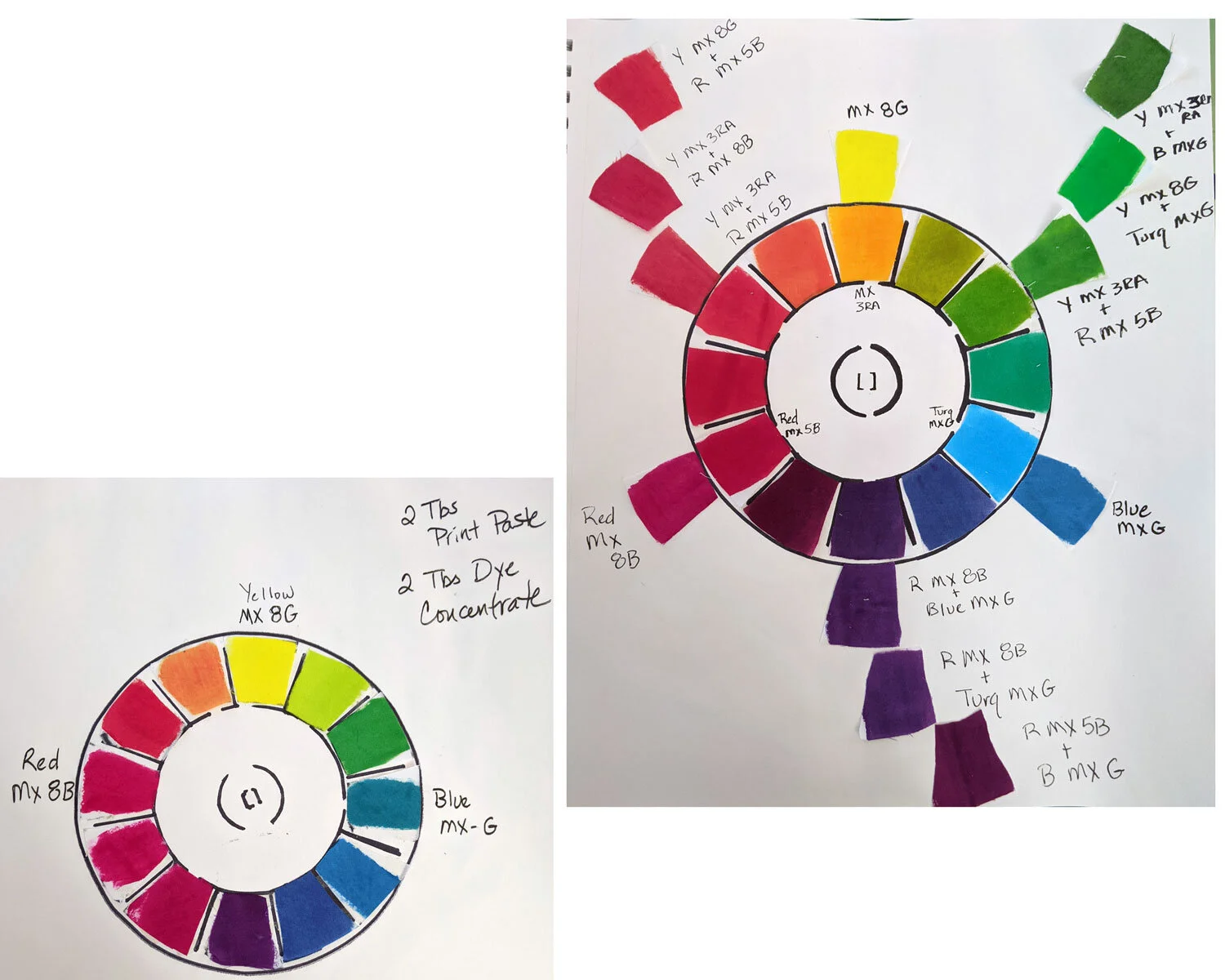
I am behind on posting images for the Dye Support Group. Life seems too busy some days to take the time to blog about my life. Rewind a couple of weeks to my first attempts at exercises from Chapter Three of Ann Johnston’s Color By Design. I learned a lot from each exercise and need to revisit several at a later date to get accurate results. I enjoyed working for my sketchbook only and had some happy accidents along the way even when I missed the mark.
Paint a Color Wheel - My first and second attempts. I need to go back and try a third time especially in the red variations.


For green, I started with an equal amount of yellow and blue and then added yellow incrementally. I approached the exercise mathematically. I thought if I started with equal amounts, I would get a base color to work from. In the future, I think I should start with yellow and add blue in small increments. The blue was dominant and it required much more yellow than I anticipated.

Lessons learned - pay better attention to painting straight so as not to overlap lines next time. I added blue to yellow this time but only in 1/4 tsp increments. I need to start on a larger piece of fabric or adjust my increments so I can get from yellow to blue.


I need better lighting in my laundry room. When wet, it appeared I was achieving black. Once dry and in better lighting, it was obvious that I need to try again. Or, stick with using the premixed black dye powders I generally use until I can try this exercise again. I really like a lot of the colors though so am keeping these pages for future reference.

I really should have started over and done all of these another time. However, I’m impatient and wanted to get to the next Chapter. So, I am working out some of the issues I had here while working on future Chapters.

Dyeing Support Group
Do you feel quarantined, lonely, and still experience a desire to dye? If so, some of my friends and I are starting a Dyeing Support Group. I love to read art books, grab a couple of tips from each, but fail to ever complete the exercises. I am challenging myself to work through all the exercises in Color By Design by Ann Johnston. My friends and I are going to work at our own pace, as we all have other things going on even if we stay in our pajamas all day. All of those 1950’s photos of women wearing heels and a dress in the kitchen were obviously staged. Through zoom and email, we will cheer, curse, and share our experiences with each other. The book is our guide and as long as we all work in the order of the exercises we should be able to support each other. We have to get creative to find ways to stay creative and motivated to reach new goals.
Day 1
Dye Mixed and in the Fridge: Warning Sign for Kids that hang out in my basement

My Studio Assistant, Indie
It looks like she didn’t read the sign, but I promise she didn’t drink the dye.
Happy Dyeing!
Dyeing Thread
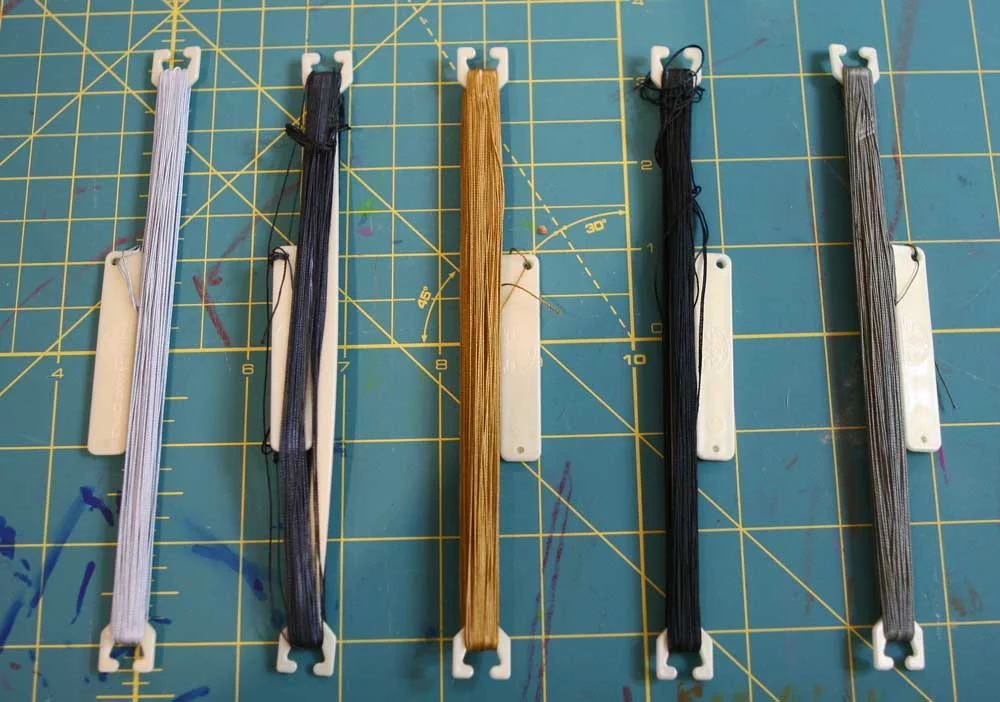
While perusing the latest Quilting Arts Magazine I was inspired to experiment with dyeing cotton thread using DMC Floss Holders after reading Thread Dyeing 101: Two Approaches by Carol Soderlund and Melanie Testa. I really want to work more in dyeing silk thread after my class with Peg Gignoux. However, this was a quick and cheap experiment since I could get all the materials on sale at Jo-Ann's with their million coupons. For the experiment I used DMC StitchBow Floss Holders and DMC Pearl Cotton Size 12 in White.
While perusing the latest Quilting Arts Magazine I was inspired to experiment with dyeing cotton thread using DMC Floss Holders after reading Thread Dyeing 101: Two Approaches by Carol Soderlund and Melanie Testa. I really want to work more in dyeing silk thread after my class with Peg Gignoux. However, this was a quick and cheap experiment since I could get all the materials on sale at Jo-Ann's with their million coupons. For the experiment I used DMC StitchBow Floss Holders and DMC Pearl Cotton Size 12 in White.
Because I generally dye in small batches, my go to book for Dyeing Recipes is Color By Accident (Low-Water Immersion Dyeing) by Ann Johnston. I wanted to experiment with colors to coordinate with some fabrics I had previously dyed in my Grey Experiment which I will detail in a subsequent post.
It is very important to take notes while you are dyeing or you will never remember dye stock amounts, dye bath timing, etc. TRUST ME!!!! YOU WILL NOT REMEMBER! I number my dye buckets or my ziplock bags with a Sharpie and then make notes in a notebook for corresponding dye stock amounts and timing.
Thread Dyeing Steps:
- wrap the thread in manageable lengths on the floss holders
- prewash the wrapped floss holders in the sink with hot water and Synthrapol
- soak wrapped floss holders in Soda Ash solution
- prepare dye stock
- decide on development time and dye stock amounts
- make note of time & dye stock amounts selected (you will never remember later so take the time to do this now before you don your rubber gloves again)
- Measure out Soda Ash solution into number buckets
- Add dye stock
- Time for desired length of time
- Drain bucket or bag
- Rinse wrapped floss holders with alternating hot and cold water until the water runs clear
- Wash wrapped floss holders by hand with Synthrapol and hot water
- Rinse
- Hang to dry
For the above threads I used 1/2 cup of Soda Ash Solution and Soaked for 15minutes.
Dye Stock Amounts for 1-5 (left to right) See Current Dye list for Experiments for additional info on Dye:
- G&K 6160 Stormy Grey 1/4 tsp
- Dharma 44 Better Black 1/4 tsp
- G&K 5193 Bronze 1/4 tsp
- Mix of Dharma 23 Cerulean Blue 1/4 tsp & Dharma 44 Better Black
- Pre Dyed in #3 then quick overdye dip in #4
I found that the dye coverage was basically consistent. I like irregularity so I wasn't trying for perfect color but with little to no effort other than wrapping loosely and agitating the dye bath once or twice the color was still pretty consistent. Wrapping tighter or wrapping longer length of thread might cause more irregularity so keep that in mind based on the results you want. After dyeing, the thread did not fuzz and sews well on the current project I am testing it on. I was happy with the way the floss holders managed the thread for dyeing and storage. They can easily be reused. Braiding lengths works well for times I want more variegation but the floss holders worked well for me for a more uniformed color.