Completed Class Project
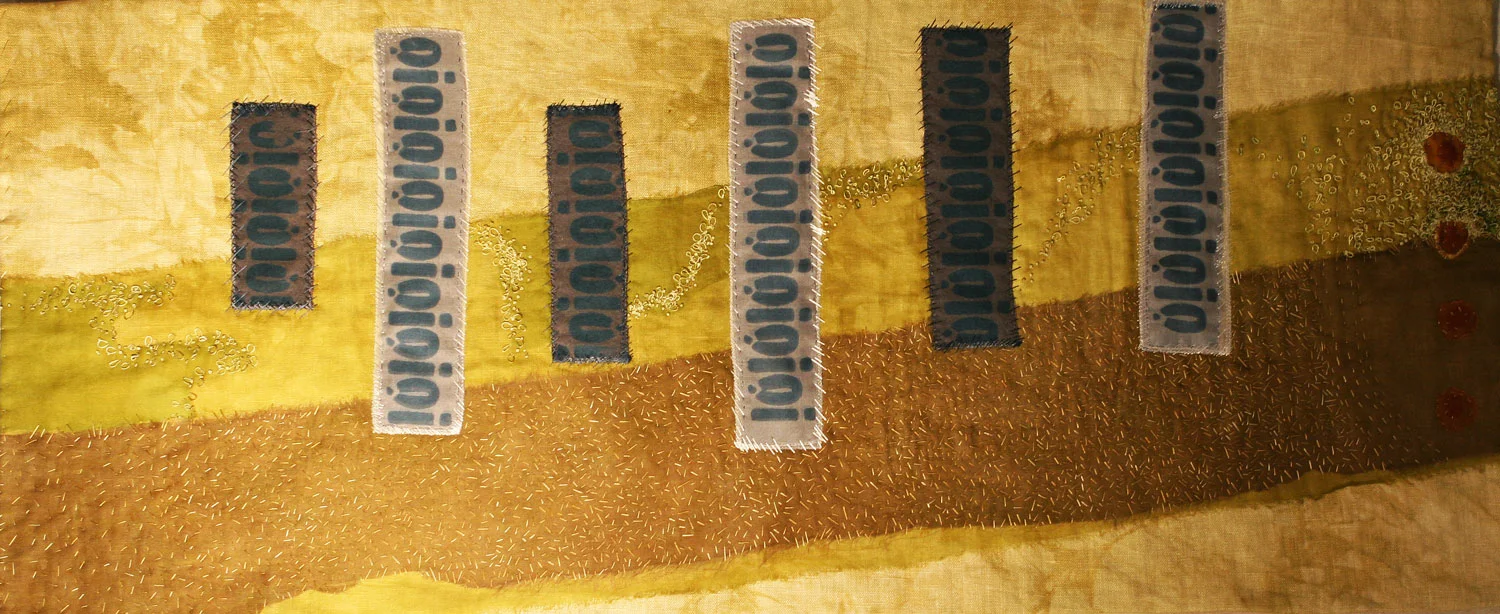
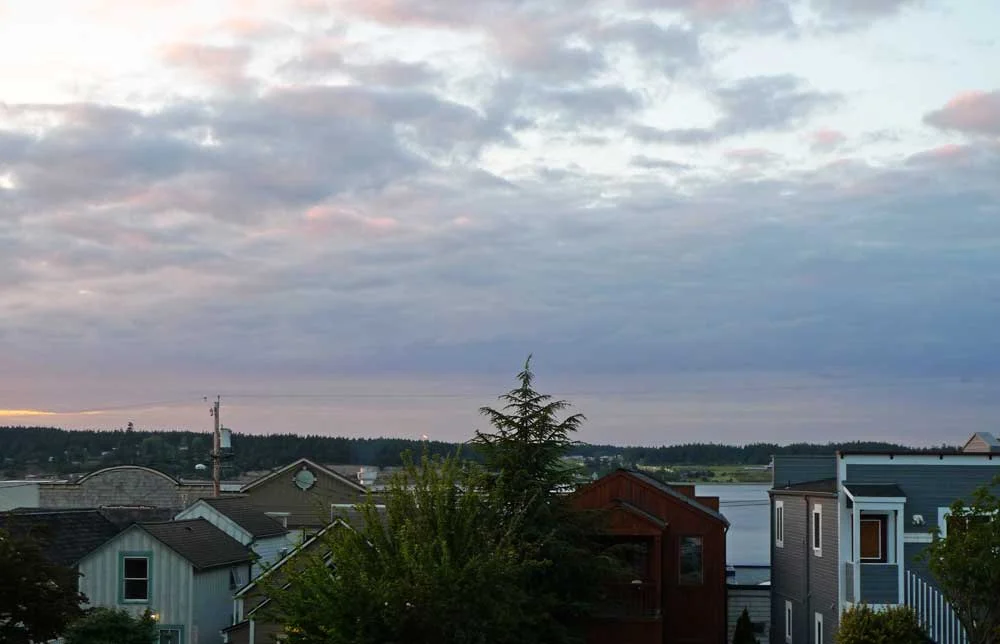
Timeline is my finished project from the Peg Gignoux workshop. Using the techniques she taught in class, I completed this piece which is quite different from my previous projects. My inspiration for this piece came from a photo I took on one of my morning walks on Whidbey Island.
Timeline is my finished project from the Peg Gignoux workshop. Using the techniques she taught in class, I completed this piece which is quite different from my previous projects. My inspiration for this piece came from a photo I took on one of my morning walks on Whidbey Island.
I took both linear elements and color concepts from this photo and incorporated them into my class project (Timeline).
The silk organza, linen, and silk threads were all dyed using Fiber Reactive Procion Type Dyes. The symbols are silk screened using thermofax screens that I borrowed from Peg Gignoux. A base layer of machine stitching anchors the layers. Utilizing the silk thread I dyed, I created a layer of mark making to add texture and depth.
In this piece I was practicing mark making utilizing hash marks, varied loops, as well as french knots. The combination of the silk organza, linen, and felt materials allowed me to play with the impact of varied materials.
For the raw edge applique, I watered down matte medium and applied it to the edges to help prevent further fraying. This worked somewhat but I would apply it multiple times before appliqueing the pieces to the background in the future. Another option would be to use Pellon 805 Wonder Under instead of the Matte Medium.
While there are a number of things I would do differently in retrospect, I am happy with the overall success of the piece. My main objective was to try something outside my comfort zone and this piece was definitely the push that I needed.
Textile Dyeing & Collage with Peg Gignoux
My class at The Pacific Northwest School of Art was taught by Peg Gignoux. I had first admired her work locally at Light Art Design during the STITCH exhibit. Ironically, she lives about 30 minutes from me but I flew cross country to attend the only workshop she had scheduled in the USA for 2014. I am very happy with that decision, as it was exactly the workshop I needed as well as being introduced to PNSA. You can view Peg Gignoux's work on her website http://www.ingignouxity.com.
My class at The Pacific Northwest School of Art was taught by Peg Gignoux. I had first admired her work locally at Light Art Design during the STITCH exhibit. Ironically, she lives about 30 minutes from me but I flew cross country to attend the only workshop she had scheduled in the USA for 2014. I am very happy with that decision, as it was exactly the workshop I needed as well as being introduced to PNSA. You can view Peg Gignoux's work on her website http://www.ingignouxity.com. The course description for the class, Textile Dyeing & Collage read as follows: "Explore the translucence and luster of silk of many weights and hues. We will hand dye silk thread and lengths of organza and habotai creating a vivid collection of fabrics to layer and stitch to linen, to cotton, to paper! Create complex colors as you blend materials, cut and redefine the surface. Add in vintage maps, old lace, antique letters and find your way into a series of expressive mixed media collages. We will play with innovative ways to work hand and/or machine stitches into the surface of each composition." (PNSA & Peg Gignoux)
In the class we covered stamping, silk screening with thermofax screens, dyeing silk fabric and thread, hand stitching, layering of organza, and basic collage techniques. We were unable to learn how to make the thermofax screens since the school did not have a thermofax machine. However, it sounded like after the class that they were going to try to include it in their future budget to obtain one for class use.
One of the products that was introduced in the class that I have used extensively since the class instruction is Pellon 805 Wonder Under which is a paper backed fusible web interfacing. I had previously used 505 Spray for join fabrics prior to sewing. However, the Wonder Under works much better for sheer fabrics and controlling frey in raw edge applique. During the class I was also converted to using multiple layers of cotton or linen fabric instead of using batting. For stiffer applications we included Watercolor Paper. Both options made it much easier to pull the silk thread through when hand-stitching.
I started experimenting with color manipulation with varied layers of silk organza during the class and plan to experiment more with this technique in one of my next projects.
Coupeville, WA
Let me start by saying I would move to Coupeville, WA tomorrow with no regrets. My experience of place was one I will always remember. Long walks every day allowed me to really explore the island within my walkable distance.
Let me start by saying I would move to Coupeville, WA tomorrow with no regrets. My experience of place was one I will always remember. Long walks every day allowed me to really explore the island within my walkable distance. The island also has free bus service to areas outside your walking comfort zone. The B&B owners picked me up from the airport shuttle stop on the island so I did not need a car the whole week I was there. Being car free enhanced my experience as you see so many things you would not notice in the confines of a car.
The island is very green even though it is in a rain shadow of the mountain and therefore does not get all the rain like Seattle. Flowers, trees, and animals are in abundance. The coolest thing though was that in June while I was visiting the sun doesn't set until after 9 at night so I was able to take long walks both in the morning and after class.
I can't say enough about my stay at The Blue Goose Inn. It wasn't overly fussy and the rooms were a nice size. The owners were overly accommodating in transporting me to and from the airport shuttle stop. Every morning the guest were greeted with a phenomenal breakfast that was included in the cost of your room. I am a Pescatarian and another guest had dairy aversion and the owners worked within the limitations and came up with dishes above and beyond expectation. They used local produce and a extensive mix of ingredients to fashion lovely meals each morning.
I did not have a bad meal the entire time I was in Coupeville. All of the restaurants had options for a Pescatarian. Being from North Carolina, I can assure you that is a rare experience for me. Also, the Chardonnays from the Pacific Northwest were wonderful. I was surprised that even the "house wine" was really good at the restaurants. Everyone says you have to try the mussels on the island. I thought they were good but it didn't blow me away. I'm not a huge oyster person either though so I may not be a good judge of mussels.
Moving on to the reason I was in Coupeville, WA................The Pacific Northwest Art School is a fabulous hidden gem. It was an intimate facility with all the basics for various art classes. It was especially nice for a fibers class as they had numerous wash sinks, clotheslines, a fabric spinner, a washer, and a dryer. The space could be divided in half for two smaller classes and there was also teaching space at Fort Casey. In reviewing their class listing, it was obvious that a lot of time and thought had been put into selecting known teachers and including a mix of disciplines.
Having graduated from a Design School (NC State College of Design) I was aware of the impact of being in a collaborative classroom environment. Working alone in my studio I have really missed the input of other artists. So much can be learned from just bouncing ideas off each other or talking about each persons varied experiences. Techniques, books, vendors, products and info about other artists to check out gets discussed while in the working environment. In North Carolina, it has been hard for me to find advanced classes offered in fiber arts. Most local classes are either in other disciplines, too Intro, or not the avenue of fiber arts I am interested in. Quilting, Weaving, Knitting, and Felting comprise the majority of Fiber Art classes in my area. On my list of To Do's is to try again to find classes available closer to home. In my next post, I will go into detail on my class at Pacific Northwest Art School.